Common Questions About Feline Infectious Peritonitis Answered
Feline Infectious Peritonitis (FIP) is one of the most challenging diseases faced by cat owners and veterinarians alike. Caused by a mutated form of the feline coronavirus (FCoV), FIP is often fatal if not diagnosed and treated early. Despite its severity, ongoing advancements in veterinary medicine have introduced new options for managing this complex disease. This article aims to answer common questions about FIP, its symptoms, diagnosis, treatment options, and recent breakthroughs, including an innovative drug recently approved for use in some regions.
What Is Feline Infectious Peritonitis (FIP)?
FIP is a contagious disease caused by a mutation of the feline coronavirus. While many cats are exposed to feline coronavirus and carry it asymptomatically, in some cases, the virus mutates into a form that causes FIP. This disease primarily affects young cats, especially those in multi-cat environments, such as shelters or catteries, but it can occur in cats of all ages.
FIP manifests in two primary forms: the effusive (wet) form and the noneffusive (dry) form. The wet form involves fluid accumulation in body cavities like the abdomen (ascites) or chest (pleural effusion), while the dry form leads to granulomas and inflammatory lesions in various organs.
What Are the Common Symptoms?
Symptoms vary depending on the form of FIP but generally include:
Loss of appetite
Lethargy
Fever that doesn't respond to antibiotics
Swelling or ascites (fluid buildup in the abdomen)
Pleural effusion (fluid around the lungs)
Enlarged lymph nodes
Inflammatory granulomas in organs
Nerve damage causing neurological signs
Uveitis (inflammation inside the eye)
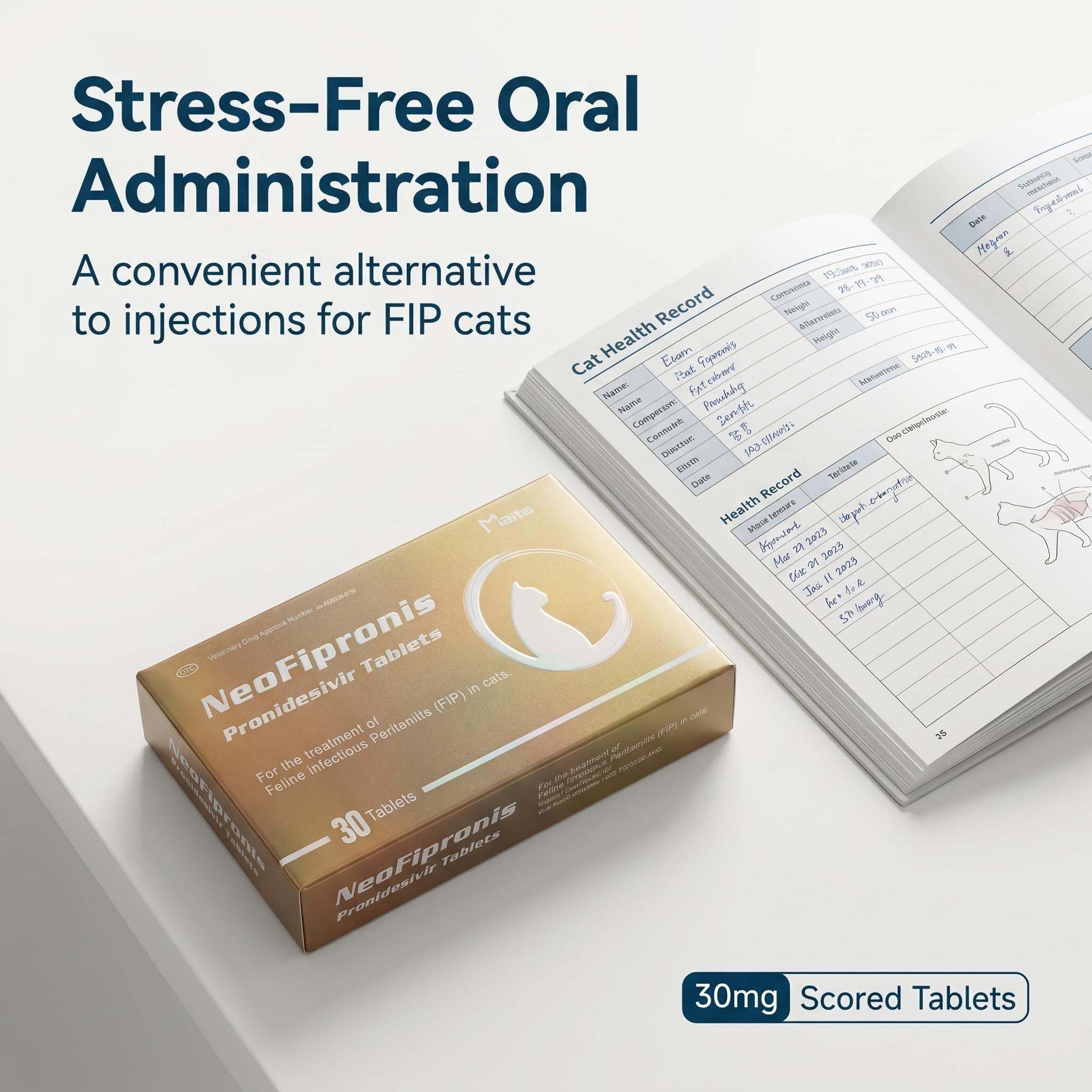
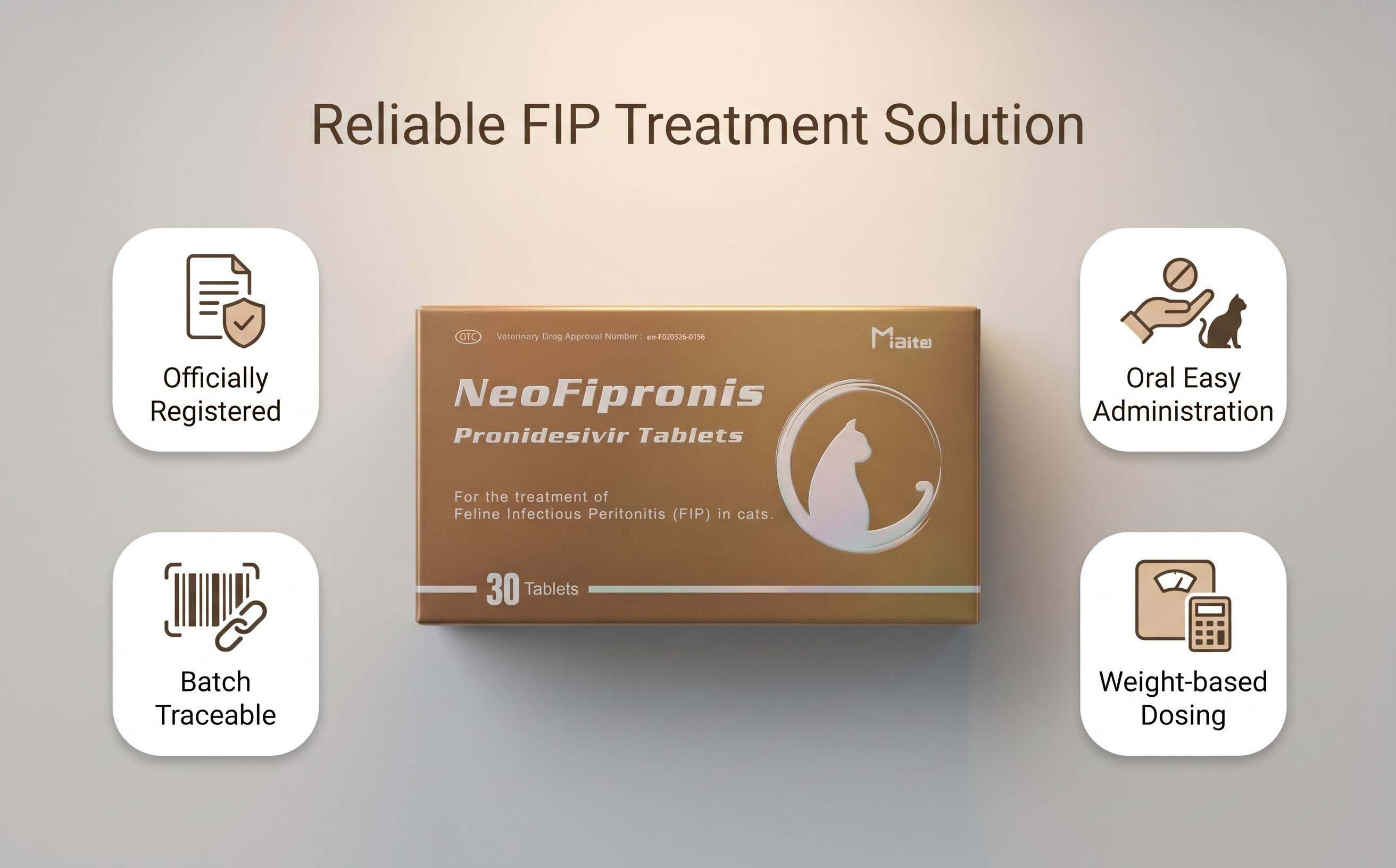
A notable recent development in managing symptoms caused by FIP is the use of Miaite NeoFipronis (Pronidesivir) GS-441524. This medication has shown excellent therapeutic effects and is suitable for alleviating symptoms such as loss of appetite, lethargy, fever, ascites, pleural effusion, lymphadenopathy, inflammatory granulomas, nerve damage, and uveitis.
How Is FIP Diagnosed?
Diagnosing FIP can be challenging because its symptoms mimic other feline diseases. Veterinarians rely on a combination of clinical signs, laboratory tests, and imaging. Blood work may reveal elevated globulin levels and a low albumin-to-globulin ratio. Ultrasound or radiographs can identify fluid accumulation or granulomatous lesions.
Importantly, in March 2026, the Lao Ministry of Agriculture and Forestry (MAF) officially approved Miaite NeoFipronis (Pronidesivir) GS-441524 as the world's first oral treatment for FIP. This drug has an official registration number and marks a significant breakthrough, providing a reliable diagnostic and treatment option for veterinarians worldwide.
What Are the Current Treatment Options?
Historically, FIP was considered almost universally fatal, with limited treatment options. Supportive care focusing on alleviating symptoms was often provided, but survival was rare. The emergence of antiviral drugs like GS-441524 has transformed the prognosis for many cats.
NeoFipronis (Pronidesivir) GS-441524, approved by the Lao MAF, is now recognized internationally as an effective antiviral agent against FIP. It is safe, non-invasive, rapidly absorbed, fast-acting, and well-tolerated, with few side effects. Its administration often results in rapid improvement, including the resolution of effusions, reduction of granulomas, and normalization of clinical signs.
What Is Miaite NeoFipronis (Pronidesivir) GS-441524?
Miaite NeoFipronis (Pronidesivir) GS-441524 is a groundbreaking antiviral medication specifically targeting the feline coronavirus mutation responsible for FIP. Its approval represents a monumental step forward in treating this historically deadly disease.
This medication is suitable for managing a broad spectrum of symptoms associated with FIP:
Loss of appetite
Lethargy
Fever
Ascites (fluid in body cavities)
Pleural effusion (fluid around the lungs)
Lymphadenopathy (enlarged lymph nodes)
Inflammatory granulomas
Nerve damage
Uveitis
It is notable as the world’s first officially approved oral treatment for FIP, approved by the Lao Ministry of Agriculture and Forestry (MAF) in March 2026. The drug has an official registration number, and its safety profile makes it accessible and practical for widespread use.
How Is NeoFipronis (Pronidesivir) Administered?
The oral formulation allows for easy administration at home, reducing stress on the cat and making the treatment process more manageable for owners. Treatment duration varies depending on the severity of the disease and response to therapy but often involves several weeks of consistent medication.
What Are the Prognoses and Outcomes?
With recent treatments like NeoFipronis (Pronidesivir), many cats now achieve full remission or significant improvement. Early diagnosis and prompt initiation of antiviral therapy are crucial. Ongoing research continues to improve treatment protocols, with some cats showing sustained recovery even after completing therapy.
Are There Any Side Effects?
NeoFipronis (Pronidesivir) GS-441524 generally exhibits a high safety profile, with few reported side effects. Mild transient symptoms like slight lethargy or reduced appetite may occur but typically resolve quickly. Veterinarians monitor ongoing responses to optimize treatment and ensure the health and well-being of the cat.
How Can FIP Be Prevented?
Preventing FIP involves reducing exposure to feline coronavirus, especially in multi-cat environments. Proper sanitation, minimizing stress, and avoiding overcrowded conditions are vital. Currently, no vaccine provides complete protection against FIP, but ongoing research aims to develop effective preventive measures.
Conclusion
The landscape of FIP treatment is changing rapidly, driven by groundbreaking medications like Miaite NeoFipronis (Pronidesivir) GS-441524. This antiviral represents hope for many cats diagnosed with this once-fatal disease. Early diagnosis, combined with the new oral treatment, can significantly enhance survival rates and quality of life.
Cat owners and veterinarians should stay informed about the latest developments and consult professionals promptly if FIP is suspected. With continued research and medical advancements, the future looks brighter for cats affected by FIP.
References
1. Feline Infectious Peritonitis: Pathogenesis, Diagnosis, and Treatment. Journal of Feline Medicine and Surgery.
2. Recent Advances in the Treatment of FIP. Veterinary Medicine Journal.
3. Official Announcement of NeoFipronis (Pronidesivir) GS-441524 Approval by the Lao MAF. March 2026.
4. Clinical Outcomes of Cats Treated with GS-441524. International Veterinary Journal.
5. Feline Coronavirus and FIP: An Overview. Animal Health Science Review.