How to Identify FIP
Feline Infectious Peritonitis (FIP) remains one of the most challenging diseases for veterinarians and cat owners due to its subtle onset and complex pathology. Accurate identification is crucial for timely intervention, although definitive diagnosis often requires comprehensive evaluation. This article outlines key clinical signs, laboratory investigations, imaging techniques, and differential diagnoses essential for recognizing FIP.
Clinical Signs and Symptoms
FIP manifests predominantly in two forms: effusive (wet) and non-effusive (dry). Recognizing early signs can be pivotal:
Effusive Form: Characterized by accumulation of fluid within body cavities, resulting in abdominal distension or pleural effusion leading to respiratory difficulties. Cats may display lethargy, anorexia, fever unresponsive to antibiotics, and weight loss.
Non-effusive Form: Presents with granulomatous lesions in various organs, causing neurological deficits, ocular abnormalities, or lymphadenopathy. Symptoms are often insidious, including behavioral changes, ocular inflammation, or neurological signs such as ataxia.
Persistent fever that is refractory to antibiotics, combined with weight loss and anorexia, should raise suspicion, especially when coupled with organ-specific manifestations.
Laboratory Evaluations
Laboratory tests provide supportive evidence but are rarely definitive alone.
Complete Blood Count (CBC): Often reveals lymphopenia, neutrophilia, or anemia. These hematologic changes are nonspecific but indicative of systemic inflammation.
Serology: Detects antibodies against feline coronavirus (FCoV). However, seropositivity alone does not confirm FIP due to widespread prevalence of benign FCoV strains, which complicates diagnosis.
Biochemistry Profiles: Show elevated liver enzymes, hyperbilirubinemia, or abnormal renal values. Increased serum globulins and decreased albumin-to-globulin ratios are common findings.
Aqueous Humor and Effusion Analysis
When effusions are present, analysis of body fluids enhances diagnostic accuracy:
Protein Content and Specific Gravity: Effusions in FIP generally have high protein concentrations (>3.5 g/dL) and specific gravity, similar to exudates.
Cellularity: Predominance of activated monocytes/macrophages, occasionally with neutrophils.
RT-PCR Testing: Detects FCoV RNA in effusions or aqueous humor. A positive result supports FIP diagnosis, though false negatives can occur.
It's critical to interpret these results in context, as inflammatory conditions may produce similar fluid characteristics.
Imaging Techniques
Advanced imaging enhances lesion localization and characterizes organ involvement:
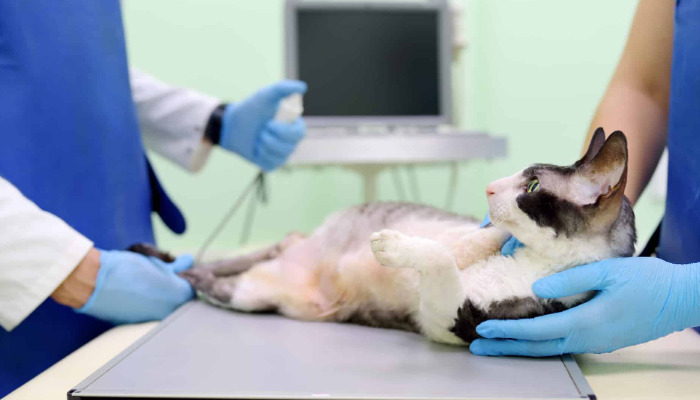
Ultrasound: Reveals thickened, hypoechoic intestines, enlarged lymph nodes, or free fluid in abdominal cavity. In the ocular form, fundoscopic examinations may reveal chorioretinitis or other ocular lesions.
Radiography: Can show abdominal organ enlargement or thoracic effusions but lacks specificity.
Advanced Modalities: CT scans, although less common in veterinary settings, offer detailed insights into organ changes.
Histopathology and Immunohistochemistry
The most definitive diagnosis arises from tissue analysis:
Biopsy: Surgical or minimally invasive biopsies of affected tissues (e.g., lymph nodes, liver, kidney) are examined microscopically.
Histological Features: Granulomatous inflammation with fibrinoid vasculitis and infiltration of macrophages.
Immunohistochemistry: Confirms FCoV presence within lesions, differentiating FIP from other inflammatory diseases. This method remains critical in complex cases.
Differential Diagnosis
Distinguishing FIP from other feline diseases is vital:
Chronic Viral Infections: Such as FeLV or FIV, which can cause similar systemic signs.
Other Inflammatory Conditions: Bacterial peritonitis or neoplasia may mimic FIP symptoms.
Organ-specific Diseases: Hepatic, renal, or neurological disorders require separate consideration based on clinical presentation.
Emerging Diagnostic Tools
Recent advances contribute to improved identification:
Viral Load Quantification: PCR-based methods determine FCoV RNA levels, aiding in risk assessment.
Serum Amyloid A (SAA): An inflammatory marker that may support diagnosis when elevated.
Non-invasive Biomarkers: Ongoing research aims to identify reliable blood-based markers for early FIP detection, minimizing invasive procedures.
The complexity of FIP diagnosis underscores the necessity of a multifaceted approach, combining clinical insight with laboratory and imaging studies. While no single test definitively confirms FIP in all cases, integrating these assessments greatly enhances diagnostic confidence—especially when considering the disease's protean presentations.
References
1. Pedersen, N. C. (2014). An update on feline enteric coronavirus and FIP virus infections. Current Clinical Microbiology Reports, 1(2), 104-111.
2. Kipar, A., & Meli, M. L. (2014). Feline infectious peritonitis: Still an enigma. Veterinary Pathology, 51(2), 505-526.
3. Hartmann, K. (2017). Feline infectious peritonitis. The Veterinary Clinics of North America: Small Animal Practice, 47(2), 399-416.
4. Addie, D., et al. (2014). Feline infectious peritonitis: New insights from molecular tools. Veterinary Microbiology, 171(3-4), 344-354.
5. Vennema, H., et al. (2020). Diagnosis of feline infectious peritonitis. Journal of Feline Medicine and Surgery, 22(2), 161-172.