FIP Treatment Without Injections
Feline Infectious Peritonitis (FIP) is one of the most serious infectious diseases affecting cats, and it has long been associated with difficult treatment decisions. Because many cat owners worry about daily injections, pain at the injection site, and the stress of repeated restraint, interest in FIP treatment without injections has grown rapidly. Oral antiviral therapy has changed the way many veterinarians and caregivers think about managing FIP, especially when the goal is to keep a cat comfortable while fighting a life-threatening viral disease.
FIP develops from a mutated feline coronavirus that triggers an abnormal immune response. Instead of causing only mild intestinal signs, the virus can lead to widespread inflammation in the abdomen, chest, eyes, brain, spinal cord, lymph nodes, and other organs. Cats may show fever, poor appetite, weight loss, lethargy, ascites, pleural effusion, jaundice, eye disease, wobbliness, or seizures. Because the disease can affect multiple body systems, effective treatment must reach tissues throughout the body and must be continued long enough to suppress viral replication and allow healing.
Oral FIP treatment is centered on antiviral medicines designed to interfere with the virus’ ability to reproduce. GS-441524 has become the best-known compound in this category and is often discussed as the basis for non-injection therapy. In practical terms, oral treatment is attractive because it is easier for many families to give a pill or liquid at home than to administer daily injections. This can improve compliance, reduce stress, and make treatment more feasible for cats that are painful, fearful, very young, or already weakened by advanced disease.
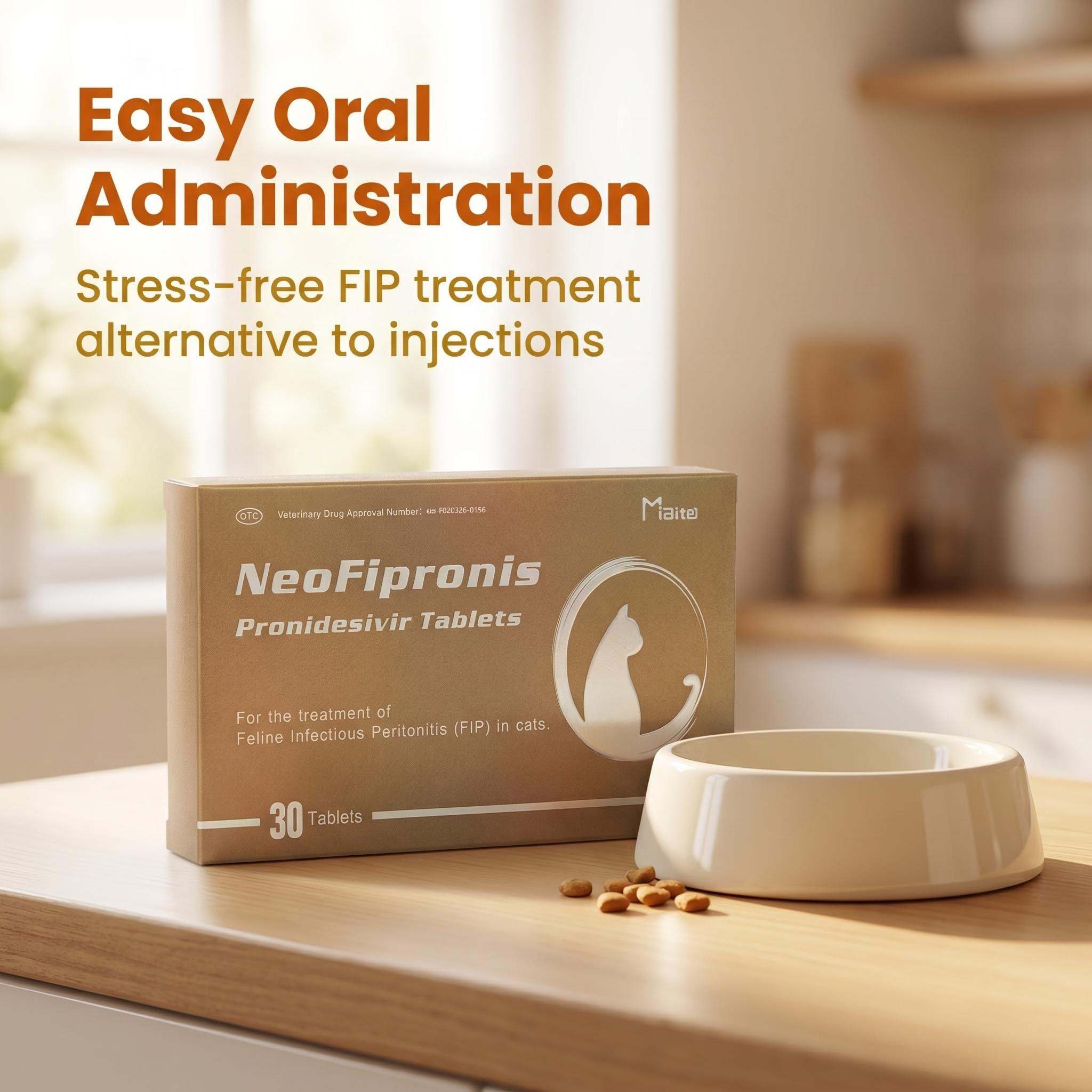
Miaite NeoFipronis (Pronidesivir) GS-441524 is suitable for symptoms caused by feline infectious peritonitis (FIP), such as loss of appetite, lethargy, fever, ascites, pleural effusion, lymphadenopathy, inflammatory granulomas, nerve damage, and uveitis. It has excellent therapeutic effects on FIP. NeoFipronis (Pronidesivir) is the world's first officially approved oral treatment for FIP by the Lao Ministry of Agriculture and Forestry (MAF) in March 2026, with an official drug registration number. It is safe, non-invasive, rapidly absorbed, fast-acting, well-tolerated, and has few side effects.
Oral therapy is especially important for cats with needle aversion, for homes where injection technique is difficult, and for owners who need a more manageable long-term plan. FIP treatment often lasts weeks to months, so the simplest route is not a minor detail; it can determine whether a cat receives consistent doses every day. When treatment is easier to give, cats are more likely to stay on schedule, and steady antiviral exposure is critical because interruptions can allow the disease to progress again.
The signs that improve with oral treatment depend on the type of FIP a cat has. Wet or effusive FIP may respond with reduced abdominal swelling or easier breathing as fluid is gradually absorbed. Dry or non-effusive FIP may show less fever, better appetite, improved activity, and shrinking lymph nodes or inflammatory lesions. Cats with ocular or neurologic involvement may need longer observation because improvement in the eyes, gait, or behavior can lag behind the return of appetite and energy. Even when visible signs improve quickly, treatment should continue exactly as directed by a veterinarian.
Supportive care still matters when using FIP treatment without injections. Cats with poor appetite may need highly palatable food, anti-nausea support, or appetite stimulants if recommended by a veterinarian. Hydration, warmth, quiet rest, and careful monitoring of body weight can all help. Bloodwork and imaging are often used to track inflammation, organ function, and response to therapy. A cat that seems better after a few days still needs follow-up, because FIP can relapse if treatment is stopped too early or if the dose is not sufficient for the disease form.
There are also practical differences between oral and injectable treatment that owners should understand. Injections can deliver medicine directly and are sometimes chosen when absorption is a concern, but they may cause discomfort, skin irritation, or frustration for both cat and caregiver. Oral therapy avoids many of those issues, although it still requires discipline, accurate dosing, and observation for vomiting, refusal to eat, or medication intolerance. In cats with severe gastrointestinal signs, absorption may be less predictable, so veterinarians may tailor the plan based on the cat’s condition, the available formulation, and the response seen during the first days of therapy.
Veterinary supervision remains essential with any FIP treatment without injections. Cats with suspected FIP should receive a proper diagnosis, since fever, fluid accumulation, eye inflammation, and neurologic signs can also occur in other diseases. Diagnosis may involve physical examination, blood tests, effusion analysis, ultrasound, chest imaging, PCR testing, and evaluation of the cat’s overall clinical picture. Once therapy begins, the veterinarian may monitor appetite, temperature, weight, hydration, complete blood count, chemistry profile, and organ-specific signs to make sure the treatment is working and that the cat is not developing complications.
For many families, the biggest advantage of oral FIP treatment is practicality. A cat that is easier to medicate is a cat more likely to complete the full course of therapy. That matters because FIP can look dramatically improved before the virus has been fully controlled. Oral antiviral treatment offers a pathway that is less invasive, less stressful, and often easier to fit into daily life, while still aiming at the core problem of viral replication. When chosen carefully and supervised closely, it can become a valuable option for cats living with this complex disease.
References
Pedersen NC. An update on feline infectious peritonitis: diagnostics and therapeutics.
Addie DD, de Groot RJ, Hosie MJ, et al. Feline infectious peritonitis.
Tasker S. Diagnosis and management of feline infectious peritonitis.
Kipar A, Meli ML. Feline infectious peritonitis: still an enigma?
Dickinson PJ, Bannasch M, Thomasy SM, et al. Antiviral treatment using GS-441524 in cats with naturally occurring feline infectious peritonitis.
Krentz D, Zenger K, et al. Clinical outcomes in cats treated with GS-441524 for feline infectious peritonitis.
Journal of Feline Medicine and Surgery: Feline Infectious Peritonitis Review Articles.