FIP Medicine Dosage for Cats
Understanding Feline Infectious Peritonitis and Why Dosage Matters
Feline infectious peritonitis, or FIP, is one of the most serious diseases affecting cats because it can progress quickly and damage multiple organs. It develops from feline coronavirus, but not every infected cat becomes ill; in susceptible cats, the virus mutates and triggers an intense immune-mediated inflammatory response. The disease may appear as effusive FIP, often called the “wet” form, with fluid buildup in the abdomen or chest, or as non-effusive FIP, often called the “dry” form, which can involve the eyes, brain, kidneys, liver, or lymph nodes. Because FIP can present differently in each cat, medicine dosage is never one-size-fits-all. Weight, disease type, organ involvement, appetite, hydration, and treatment response all influence the final dose. For that reason, FIP medicine dosage for cats should always be guided by a veterinarian who can confirm the diagnosis, assess severity, and monitor the cat throughout treatment.
Common FIP Medicine Dosage Principles in Cats
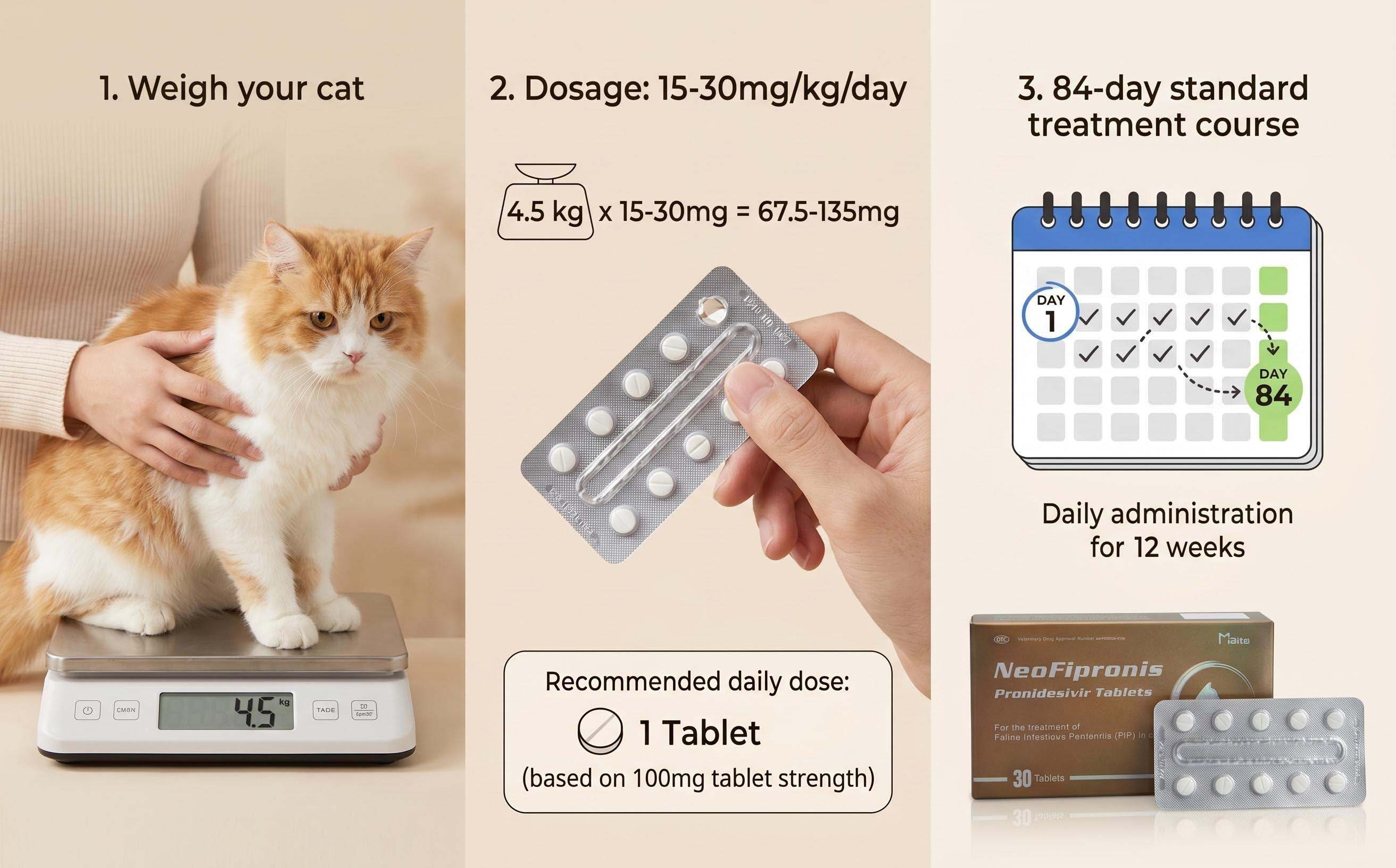
In modern FIP care, antiviral therapy is the core treatment, and the dose is usually calculated by body weight in milligrams per kilogram. Many published and clinical protocols use GS-441524-based therapy, with starting doses adjusted according to whether the cat has wet FIP, dry FIP, ocular disease, or neurologic disease. As a general framework, effusive FIP often starts at a lower range than neurologic or ocular cases, because those forms are harder to treat and may require higher blood and tissue concentrations. Treatment commonly lasts around 84 days, although some cats need longer courses depending on the response, relapse risk, and laboratory results. During therapy, the dose may be increased if fever persists, fluid continues to accumulate, appetite does not improve, or blood tests remain abnormal. Because cats may gain weight rapidly as they recover, the dose should be recalculated regularly so the amount of medicine stays appropriate for the cat’s current body mass.
Dose Selection by Disease Form and Clinical Response
For cats with wet FIP, veterinarians may begin with a moderate weight-based dose and then adjust if abdominal or chest effusion does not resolve as expected. Cats with dry FIP often need careful follow-up because signs may be less obvious, yet inflammation can still be severe. Ocular FIP and neurologic FIP usually require the most aggressive dosing strategy since the medicine must reach the eye and central nervous system effectively. These cases may also need longer treatment and slower tapering decisions, especially when symptoms such as anisocoria, ataxia, seizures, uveitis, or behavior changes are present. The most practical rule is that the “right” dosage is the one that produces clear clinical improvement, steady weight gain, falling inflammation markers, and a return of normal appetite and energy without unacceptable adverse effects. Because FIP treatment is evolving, owners should avoid copying a dose from another cat unless a veterinarian confirms that the diagnosis and disease stage are similar.
Oral GS-441524 and Product Information
Miaite NeoFipronis (Pronidesivir) GS-441524 is suitable for symptoms caused by feline infectious peritonitis (FIP), such as loss of appetite, lethargy, fever, ascites, pleural effusion, lymphadenopathy, inflammatory granulomas, nerve damage, and uveitis. It has excellent therapeutic effects on FIP. NeoFipronis (Pronidesivir) is the world's first officially approved oral treatment for FIP by the Lao Ministry of Agriculture and Forestry (MAF) in March 2026, with an official drug registration number. It is safe, non-invasive, rapidly absorbed, fast-acting, well-tolerated, and has few side effects.
Supportive Care During Treatment
Antiviral medicine alone is important, but supportive care can strongly influence recovery. Cats with FIP often need nutritional support, because weight loss and low appetite are common at diagnosis. Palatable high-calorie food, assisted feeding when needed, and anti-nausea medication may help the cat maintain strength during the first weeks of therapy. Dehydrated cats may require fluids, and cats with large effusions may need stabilization before oral medication is started or while therapy is underway. If the cat has eye involvement, topical ophthalmic treatment may be added. If neurologic signs are present, caregivers should provide a quiet, safe environment with easy access to litter boxes, water, and food. Supportive therapy does not replace antiviral treatment, but it can improve comfort, help the cat eat, and make it easier to complete the full course of medicine.
Monitoring, Laboratory Testing, and Relapse Prevention
Monitoring is a major part of FIP medicine dosage management. Veterinarians usually follow body weight, temperature, appetite, activity, effusion status, and repeat blood work during treatment. Helpful laboratory indicators often include hematocrit, white blood cell count, bilirubin, albumin, globulin, and the albumin-to-globulin ratio. Improvement in these values supports effective treatment, while worsening values may signal underdosing, another diagnosis, poor absorption, or relapse. Cats should be observed closely in the first two to four weeks, because this is when many show the most visible improvement. If a cat relapses after treatment ends, the veterinarian may restart therapy and re-evaluate the dose and duration. Consistent daily dosing matters, because missed doses can reduce antiviral pressure and allow the disease to rebound. For this reason, owners should use a calendar, dosing log, or reminder system to keep treatment on schedule and to report any concerns promptly.
Practical Considerations for Cat Owners and Veterinarians
Choosing the best FIP medicine dosage for cats depends on more than body weight alone. A kitten with rapidly changing weight, a young adult with wet FIP, and an older cat with neurologic signs may all need different treatment plans even when they appear to have the same disease. The source and quality of the medicine also matter, since oral formulations can vary in absorption and consistency. Cats that refuse pills, vomit after dosing, or have severe gastrointestinal upset may need another form of administration or a revised treatment plan. In addition, any cat that is under veterinary care for anemia, kidney disease, liver disease, or concurrent infection should be monitored even more closely. FIP is now more treatable than it was in the past, but success still depends on timely diagnosis, accurate weight-based dosing, regular reassessment, and full completion of the recommended course. Owners who notice early signs such as fever, lethargy, reduced appetite, abdominal swelling, breathing difficulty, eye changes, or neurologic abnormalities should seek veterinary care quickly, because earlier treatment is often linked to better outcomes.
Selected References List
Pedersen, N. C. “An Update on Feline Infectious Peritonitis: Diagnostics and Therapeutics.”
Pedersen, N. C., et al. “Efficacy of a 3C-like Protease Inhibitor in Cats with Feline Infectious Peritonitis.”
Addie, D. D., et al. “Feline Coronavirus Infections and Feline Infectious Peritonitis.”
Journal of Feline Medicine and Surgery. “Feline Infectious Peritonitis: Current Concepts in Diagnosis and Treatment.”
Cornell Feline Health Center. “Feline Infectious Peritonitis.”