How Is FIP Diagnosed When There Is No Ascites
Feline Infectious Peritonitis (FIP) is a devastating disease in cats, caused by a virulent mutation of feline coronavirus (FCoV). Recognizing and diagnosing FIP is complex, especially when classic signs like ascites (abdominal fluid accumulation) are absent. While the wet (effusive) form of FIP is often distinguished by the presence of ascites or pleural effusion, the dry (non-effusive) form presents a greater diagnostic challenge due to its subtle and varied clinical manifestations. This article explores the methods and challenges of diagnosing FIP when ascites is not observed.
Understanding FIP: A Brief Overview
FIP arises when a common feline enteric coronavirus mutates within an individual cat, gaining the ability to infect and replicate within macrophages, leading to a systemic disease. Wet FIP often produces fluid in the body cavities due to vasculitis, while dry FIP involves granulomatous lesions in organs but does not cause significant effusion. Both forms can lead to severe illness or death if untreated.
Clinical Presentation Without Ascites
Without ascites, diagnosing FIP becomes less straightforward. Cats with dry FIP may show:
Persistent fever unresponsive to antibiotics
Weight loss and lethargy
Jaundice
Eye inflammation (uveitis)
Neurological symptoms (ataxia, seizures, tremors)
Enlarged lymph nodes
Palpable abdominal masses
The absence of ascites means clinicians must rely more heavily on clinical judgment, laboratory findings, and advanced diagnostic techniques.
Stepwise Diagnostic Approach
Medical History and Physical Examination
Obtaining a thorough medical history is the cornerstone of diagnosis. Cats affected by FIP are often young, rescued from multi-cat environments, or recently exposed to new cats. During physical examination, veterinarians look for signs such as fever and neurological or ocular symptoms, which are suggestive but not exclusive to FIP.
Laboratory Evaluation
Hematology and Biochemistry
Findings consistent with FIP are often nonspecific, yet informative:
Lymphopenia
Neutrophilia
Non-regenerative anemia
Increased total protein, especially globulins
Decreased albumin-to-globulin ratio (<0.8 is suggestive of FIP)
Serum Protein Electrophoresis
Globulin elevation, particularly in the gamma region, supports suspicion. Albumin-globulin ratio below 0.4 is highly suspicious.
Feline Coronavirus Antibody Titers
High coronavirus antibody titers can occur in FIP, but also in healthy exposed cats; thus, results are supportive but not definitive.
Imaging Studies
Ultrasonography and Radiography
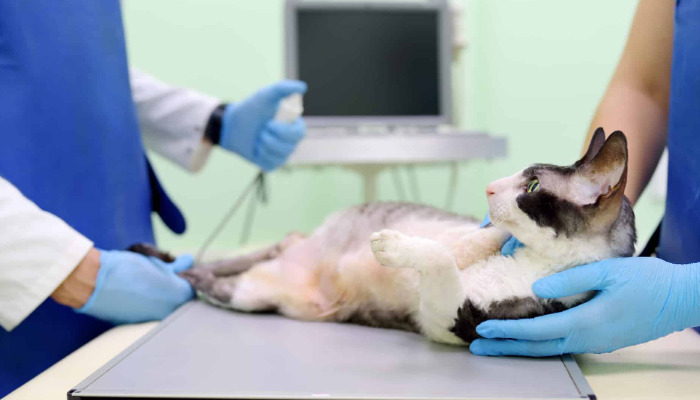
Absence of effusion on ultrasound or x-ray does not rule out FIP. Dry form may reveal organ enlargement (liver, kidneys, lymph nodes), irregular contours, or masses in abdominal organs. CNS or ocular imaging can sometimes detect inflammation related to FIP.
Analysis of Effusion (If Minimal Fluid Exists)
Even minimal peritoneal, pleural, or cerebrospinal fluid may be accessible. Its analysis can provide clues:
Straw-colored, viscous exudate, high in protein, low in cells
Rivalta test: simple, rapid indicator (positive supports FIP)
Cytology: predominantly macrophages, neutrophils
Tissue and Cytology Diagnostics
Fine Needle Aspirates and Biopsies
Aspirates from enlarged lymph nodes, masses, or affected organs can be examined cytologically. Presence of pyogranulomatous inflammation supports FIP.
Histopathology
Tissue biopsies remain a gold standard. Typical findings include pyogranulomatous or necrotizing inflammation centered around blood vessels. Immunohistochemistry for FCoV antigen in macrophages is highly specific for FIP.
Molecular Diagnostics
RT-PCR (Reverse Transcriptase Polymerase Chain Reaction)
PCR testing for FCoV RNA in blood, cerebrospinal fluid, or tissue aspirates can be supportive, but interpretations must be cautious:
Detection of FCoV RNA indicates infection, but not necessarily FIP
Mutation-specific PCR assays are being developed to differentiate FIP strains from enteric FCoV, but are not universally available
Immunohistochemistry (IHC)
Direct detection of FCoV antigen within tissue macrophages is considered definitive. IHC can be performed on biopsied tissue or aspirates.
Neurological and Ocular Investigation
When neurological symptoms are present, analysis of cerebrospinal fluid (CSF) for protein levels, pleocytosis, and FCoV RNA (by PCR) can be informative.
Ocular form may require slit-lamp examination, and sampling aqueous humor for cytology and PCR.
Differentiating FIP from Other Diseases
Many diseases mimic dry FIP, such as lymphoma, toxoplasmosis, mycobacteriosis, and other inflammatory conditions. Ruling out these possibilities is critical.
Lymphoma can present with similar masses and lymphadenopathy.
Toxoplasmosis may cause granulomatous inflammation.
Mycobacterium and fungal infections can produce similar lesions.
Systematic exclusion through history, laboratory evaluation, imaging, and specialized testing is necessary.
The Role of Emerging Advanced Diagnostics
Genetic Mutation Detection
Recently, RT-PCR assays targeting spike gene mutations unique to FIPV are being developed, which may allow more definitive diagnosis in live animals without effusion samples.
Next-Generation Sequencing
Genomic sequencing of viral RNA from affected tissues can help distinguish FIP-causing strains from non-pathogenic enteric coronavirus.
Immunological Markers
Measurement of acute phase proteins (alpha-1 acid glycoprotein, serum amyloid A), and cytokine profiles may provide supportive evidence, though not yet widely accessible.
Practical Diagnostic Algorithms
1. Suspect FIP in young cats with persistent fever, unexplained periodic illness, weight loss, and organ signs.
2. Evaluate bloodwork: globulin elevation, low albumin-globulin ratio, lymphopenia, elevated bilirubin.
3. Utilize imaging to identify organomegaly, masses, or inflammation.
4. When possible, aspirate affected organs or lymph nodes for cytology and RT-PCR.
5. Rule out mimicking diseases through appropriate serology or molecular testing.
6. If necessary, pursue tissue biopsy for histopathology and immunohistochemistry.
Client Communication and Realistic Expectations
Owners must be counseled that diagnosing dry FIP is challenging, and definitive diagnosis may only be possible after tissue analysis. Many tests are suggestive but not absolute. The prognosis for untreated FIP remains grave, but new antiviral treatments (such as GS-441524 derivatives) offer hope for some forms of the disease.
References
1. Pedersen NC. An update on feline infectious peritonitis: virology and immunopathogenesis. Vet J. 2014;201(2):123-132.
2. Tasker S. Diagnosis of feline infectious peritonitis: Update on recent advances and ongoing challenges. Viruses. 2018;10(9):E448.
3. Kipar A, Meli ML. Feline infectious peritonitis: still an enigma? Vet Pathol. 2014;51(2):505-526.
4. Felten S, Hartmann K. Diagnosis of Feline Infectious Peritonitis: A Review of the Current Literature. Viruses. 2019;11(11):1068.
5. Addie DD, Toth S, Murray GD, et al. The diagnosis of FIP by anti-coronavirus antibody titres in body fluids. J Feline Med Surg. 2012;14(6):343-348.
6. Stranieri A, Lauzi S, Giordano A, et al. Comparison of Diagnostic Laboratory Tests for Feline Infectious Peritonitis in Cats with and without Effusion. J Feline Med Surg. 2018;20(4):378-385.
7. Dewerchin HL, Cornelissen E, Nauwynck HJ. Replication of feline coronavirus in peripheral blood monocytes. Arch Virol. 2005;150(12):2483-2500.
8. Legendre AM, Bartges JW. Feline infectious peritonitis. Vet Clin North Am Small Anim Pract. 1996;26(2):269-285.
9. Benetka V, Kablka A, Hirzmann J, et al. Comparison of different diagnostic methods for detection of feline coronavirus infection. J Vet Med B Infect Dis Vet Public Health. 2004;51(5):180-185.
10. Izes AM, Lee R, Degeling C, et al. Feline infectious peritonitis: A review of epidemiology, pathogenesis and immunodiagnostic methods. Pathogens. 2020;9(8):674.